One in five British adults used an AI tool for news last month, according to Ofcom. firstlight is tracking what those tools say about the Prime Minister, and the sources behind their answers.
On 30 September, Google’s AI assistant, Gemini, was asked about the weaknesses of Andy Burnham’s record as Mayor of Greater Manchester.
In an apparently even-handed summary, it noted several criticisms attributed to “critics and local opponents”. Yet anyone checking the links would have found something odd: eight of the 11 citations behind the answer came from a single Facebook post by Joy Morrissey, the Conservative MP for Beaconsfield in Buckinghamshire.
Gemini also powers Google’s AI Overviews, the summaries at the top of search results, which reach over 2 billion people globally and appear on nearly half of all UK web searches. ChatGPT and other AI platforms draw hundreds of millions more. Social feeds can be loud, tribal and polarising, and are widely blamed for having fractured politics. By contrast, an AI tool sounds calm, methodical, inherently trustworthy. Yet its tone can mask a patchwork of questionable sources, including social media posts themselves – introducing a quieter, less visible kind of distortion into politics.
Voters say they are wary of AI answers. In May 2026, 49% of adults told the think-tank Demos that they do not trust AI for election information – with good reason, as 34.1% of the answers it tested about that month’s UK elections contained factual errors. Yet in practice almost nobody checks the working. A July 2025 study by the Pew Research Center in the United States found that when Google showed an AI summary, users clicked a cited link in just 1% of visits.
The Brand Burnham Tracker
firstlight has tracked what leading AI tools – including Google AI Overviews, Gemini, ChatGPT and Perplexity – say about Andy Burnham every day since mid-July, a week before he became Prime Minister. The tracker puts a range of questions to the platforms daily – asking about him directly, inviting criticism, or omitting his name entirely – gathering tens of thousands of answers and the sources behind them.
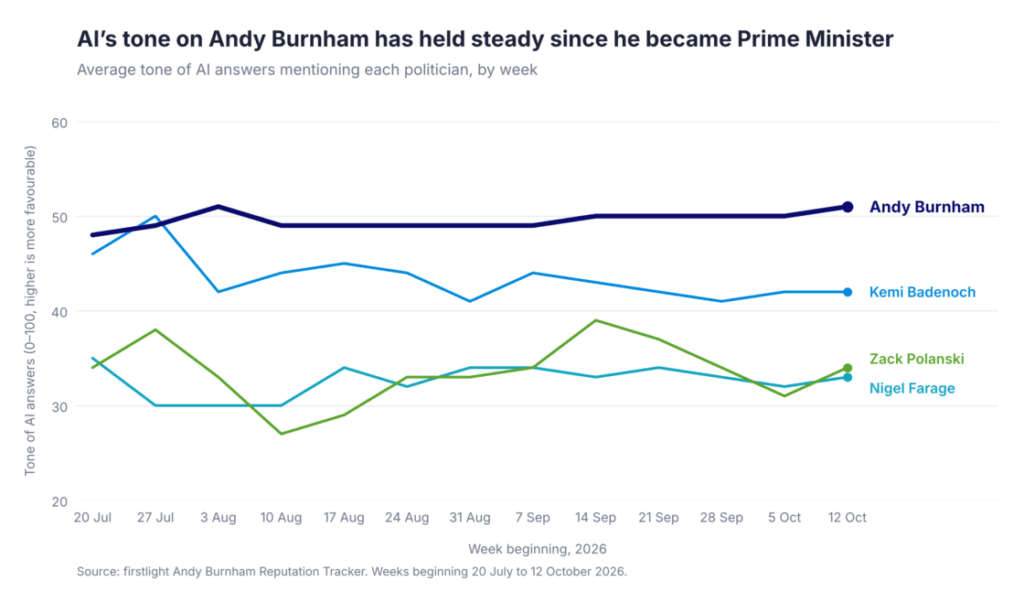
Each week our analysis places him in one of five bands: “commanding”, “secure”, “contested”, “exposed” and “damaged”. As you might expect of a sitting Prime Minister in these febrile times, Burnham typically sits in the “contested” and “exposed” bands, but the tone of answers about him has remained remarkably steady, putting him ahead of Kemi Badenoch and well ahead of Nigel Farage and Zack Polanski.
What’s feeding the answers?
Looking beneath the headline scores reveals three main routes political material takes into AI answers – and how easily the picture gets skewed.
One is social media. Our opening example was not a one-off. Google AI Overviews has cited Facebook in around half of the answers we have tracked since Burnham took office – turning individual partisan posts into what reads like settled local consensus.
Another is party websites. Reform UK’s web page “How Andy Burnham betrayed the victims of grooming gangs” has been cited in Google AI Overviews every week since he entered No 10. Since mid-August, Gemini also cites the Conservatives’ page “Andy Burnham has a spending problem”. But party sites work in his favour as well: Labour’s own website has been cited around 1,500 times since he took office – more than ten times as often as Reform’s – mainly through its profile of him and its coverage of his leadership win and conference speech.
A third is which newspapers let AI companies read their journalism. Since he took office, the Guardian has been cited in 39% of answers, the Telegraph in 2%, and the Daily Mail just once. The reasons are largely technical and commercial: paywalls, blocks on AI web crawlers and licensing deals. When major right-leaning titles shut crawlers out, they leave a gap where perhaps more critical reporting would normally sit. Effectively starved of material, AI platforms fill that void with party websites and social posts (though we should not discount the extent to which the likes of the Daily Mail and the Telegraph influence that content).
The data so far
Some parties are already exceptionally visible in these summaries. A study reported by the Guardian in May 2026 found Reform UK in 88% of Google AI Overview answers on British politics, with Facebook the most-cited source. In September, Reform accepted two donations totalling £72m – more than Labour and the Conservatives spent combined at the last general election. As that money is spent on campaigning and content, Reform’s presence in AI answers could grow. If a few wealthy donors can fund the content that AI tools pass on to millions of voters, how AI platforms choose and weigh their sources matters even more.
What’s next?
Foreign interference raises a separate risk. Social media is already an attack surface for hostile states, which have used troll and bot networks to target major votes. It is highly likely AI answers will be the next one. There are early signs. A Russian network known as Pravda published millions of articles in 2024, and when NewsGuard tested ten leading AI tools on the network’s false claims the following year, a third of their answers repeated them. We will be alert to the same pattern in AI answers about British politics.
As the Chancellor, John Healey, prepares to deliver the Budget on 28 October, we will examine what AI tells voters about whether the Prime Minister can pay for his promises – and how the Budget shifts both the answers and the sources behind them.
Politics is the sharpest test case for a shift now affecting every organisation. The same mechanics shaping answers about the Prime Minister – the balance between earned media, owned content and social media, and how models weight sources – also dictate how AI platforms represent businesses, leaders and complex issues. We built this tracker as part of firstlight’s AI visibility and Generative Engine Optimisation (GEO) practice: helping organisations see not just what AI says about them in the wild, but what is driving those answers and how to shape them.